


Master’s Without IELTS or PTE How to Apply Before Your Work Permit Expires and Help Your Spouse Get Open Work Permit

Your work permit expiring in 90 days can make every choice feel urgent. If you’re on a PGWP and thinking about a Master’s program, the good news is this: IELTS or PTE may not be the only way to prove English.
Many Canadian universities and private institutions that offer eligible graduate programs accept other proof of English ability, depending on your background. The key is to move fast, stay organized, and avoid guessing.
This guide walks through the options, the documents, and the timeline so you can make a realistic plan before your status runs out.
You may have English proof without taking IELTS or PTE
A lot of people assume every Master’s program needs IELTS or PTE. That’s not always true.
Universities often publish an English language proficiency page with accepted alternatives. If you studied in English before, worked in an English-speaking environment, or completed education in Canada, you may already have what they need.
Common alternatives include:
Medium of Instruction letter
A letter from your previous college or university confirming your degree was taught in English.
Previous education in English
Some schools waive English testing if you completed a degree in an English-speaking country or at an English-medium institution.
Canadian credential
If you completed a Canadian diploma, degree, or certificate, some universities may accept that as proof.
University’s own English assessment
A few schools offer internal English tests or interviews.
Other accepted tests
Some institutions accept CAEL, TOEFL iBT, Cambridge English, or other approved options. Always check the specific school’s list.
If your search phrase has been No IELTS or PTE or Duolingo, focus on schools that clearly mention waivers or alternative documents. Don’t rely on agent screenshots or old posts. Email admissions and get confirmation in writing.
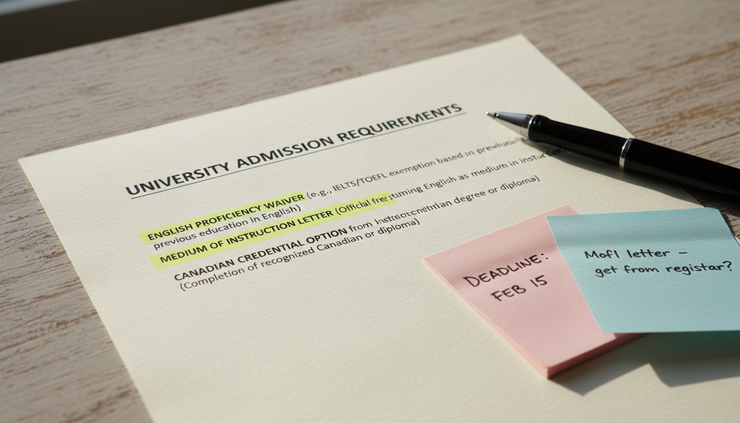
Your 90-day plan needs to be tight but doable
With only 90 days left, the biggest risk is not the English test. It’s missing deadlines or waiting too long for documents.
Here’s a practical timeline.
Time left | What to do |
Days 90 to 75 | Shortlist Master’s programs and check English waiver rules |
Days 75 to 60 | Request transcripts, degree certificates, and Medium of Instruction letters |
Days 60 to 45 | Submit applications and pay application fees |
Days 45 to 30 | Follow up with admissions and upload missing documents |
Days 30 to 15 | If accepted, pay deposit and request final Letter of Acceptance |
Final 15 days | Prepare your study permit application and restoration or status plan if needed |
Some Master’s programs have several intakes, while others accept students only once or twice a year. January, May, and September intakes are common, but not every program offers all three.
If your work permit expires before classes start, speak with a licensed immigration professional about your options. You may need to consider changing your status, applying before expiry, or dealing with restoration if you’ve already fallen out of status.
This article is general information, not legal advice.
Documents you should start collecting now
Don’t wait for a university to ask twice. Gather everything early, scan it clearly, and name files in a way you can find quickly.
You’ll usually need:
Passport
Current work permit
Canadian study records, if you studied in Canada
Official transcripts
Degree certificate or completion letter
Resume
Statement of purpose
Letters of reference
Medium of Instruction letter, if asking for an English waiver
Proof of name change, if applicable
Application fee payment
Proof of funds, later for the study permit stage
Your statement of purpose should explain why the Master’s makes sense after your Canadian education or work experience. Keep it honest and specific. Admissions teams can tell when someone sends the same generic paragraph to 10 schools.
A simple structure works well:
What you studied before
What work experience you gained
Why this Master’s program fits your goals
Why now is the right time
How you plan to use the degree after graduation
A Master’s program can also support your spouse’s open work permit plan
One major reason many PGWP holders look at a Master’s program is family planning. In Canada, spouses or common-law partners of eligible international students may be able to apply for an open work permit, depending on the program and current IRCC rules.
A Master’s degree program can be helpful because graduate-level studies often fall within categories that may support spousal eligibility. That said, rules can change, and not every school or program creates the same immigration outcome.
Before choosing a program, confirm:
The institution is a Designated Learning Institution
The program is eligible for a study permit
The Master’s program meets current spouse open work permit rules
Your own study permit application is strong
Your spouse has the right supporting documents
For the Spousal Open Work permit, your spouse may need documents such as your study permit approval, proof of relationship, proof of enrolment, and other personal documents. The exact package depends on timing and circumstances.
Don’t pick a program only because it sounds easy to enter. Choose one that makes academic, immigration, and financial sense.
How to apply without losing time
Start with a shortlist of 2 to 3 programs. Make sure each one has three things:
A realistic admission requirement
A nearby intake
A clear English waiver or alternative proof policy
Attach your transcript if needed, but don’t send every document in the first email unless they ask.
Once you get a positive response, apply right away. Admission review can take time, and missing one document can push your file back by weeks.
If you’re in Vancouver, Surrey, or elsewhere in Canada and need help building a study plan before your PGWP expires, you can speak with Admire Immigration about your options.
FAQ
Can I really get admission to a Master’s without IELTS or PTE?
Yes, some universities allow it if you qualify for an English waiver or can provide accepted alternative proof. The rules vary by school and program.
Should I apply to any Master’s program just to keep status?
No. A weak or unrelated program can create problems later. Choose a program that fits your education, work history, and future goals.
Can my spouse apply for an open work permit once I start my Master’s?
Possibly, if your program and situation meet current IRCC requirements. Check the latest rules before applying.
What if my PGWP expires before I get admission?
You’ll need a status plan right away. Depending on timing, options may include applying to change conditions, visitor status, restoration, or another lawful route.
Your next step should be simple
Don’t spend the next two weeks worrying about IELTS or PTE before checking waiver options. Start with the schools, confirm their English rules, request your documents, and apply before deadlines close.
With 90 days left, speed matters. But clear decisions matter more. A well-chosen Master’s program can protect your study path, support your long-term plans, and may help your spouse qualify to work in Canada too.
Admire Immigration Services Inc.
6330 Fraser St Unit 307 3rd Floor, Vancouver, BC V5W 3A3. Phone/Whatsapp: +1-778-925-3008
Payal Business Centre, 8148 128 St Unit 385, Surrey, BC V3W 1R1. Phone/Whatsapp: +1-778-683-3008
Kanwarjit Singh Lall
Regulated Canadian Immigration Consultant (RCIC) - Helping you navigate the 2026 reforms.


Comments